What Is Generative Engine Optimization? A Founder’s Guide
What GEO means, what the paper that named it actually tested, and five questions that tell you whether it is worth paying for yet.

In this article
Generative engine optimization (GEO) is the work of making AI engines name, cite and correctly describe your brand when a buyer asks them a question. You cannot edit what ChatGPT, Perplexity, Gemini or Google's AI Overviews say. You can change the evidence they draw on. Whether that is worth paying for depends on how your buyers decide.
What does GEO change?
Three inputs: how accurately the web describes your brand, how plainly your own pages answer buyers' questions, and what independent sources publish about you. Engines build answers from that evidence, and when the inputs change consistently the answers shift. Progress is measured over a fixed set of buyer questions, not by one screenshot.
Two outcomes matter, and they fail separately. Presence is whether you are named at all. Accuracy is whether what the engine says is true: your price, your founder, where you ship. Our measurement field notes put it bluntly: "Presence was never the issue. Accuracy was." That is why we score accuracy apart from presence and why correction comes before amplification in every engagement we run.
On control, our position is just as plain: "Nobody can edit an AI model's output. What you can change is the evidence it draws on." An agency that promises control is overselling.
Where the term came from, and what that paper actually tested
The name comes from a 2023 paper by Pranjal Aggarwal and co-authors, presented at KDD 2024. It tested rewritten web pages on a research engine that read the top five Google results per query, and measured how much of each AI-written answer a page supplied. That is narrower than what agencies sell under the name.
Wikipedia's entry dates the term to that 2023 paper and its KDD 2024 presentation, and the paper itself is worth ten minutes of a founder's time, because three details change how you should read every GEO pitch.
First, what "visibility" meant. The main metric counts the words in the generated answer that cite a page, weighted so that earlier citations count more. It measures how much of an answer a source supplies, not whether a product gets recommended.
Second, which questions. The benchmark holds 80% informational queries, with transactional and navigational queries at 10% each, and each query came with the text of its top five Google results. A buyer asking which merino base layer to buy for wet hikes under €100 belongs to the smallest part of that mix.
Third, who gained. In the paper's test where every source was optimized at once, adding citations raised visibility 115.1% for the page ranked fifth, while the top-ranked page lost 30.3% on average. Fifth means fifth of the five Google results the engine read, so still page one; a store on page three was never in the test. The direction still fits our view that right now "being small and specific is an advantage rather than a handicap. It won't last."
The 40% figure
Some explainers lead with one number from the paper. Emeritus, for example, says GEO "can enhance visibility in generative search results by up to 40%". Our claims audit rates "GEO delivers a 40% visibility improvement" false as commonly stated. What it supports is narrower: adding citations, quotations and statistics, and improving fluency, produced visibility gains reported at up to approximately 40% under test conditions. In the audit's words, "that figure is a relative, experiment-specific result on controlled rewrites, not a forecast for a commercial website." We do not quote it as an outcome, and you should discount any proposal that does.
What GEO work actually consists of
The evidence-backed part is narrow. Our claims audit boils it down to making sure engines can retrieve you, making sure what they say about you is correct, and structuring content so a specific question gets a liftable answer. Our own work adds earning independent coverage, which is a position from practice, not an audit finding.
In order:
- Access. Engines reach your site through different crawlers. ChatGPT search relies on OpenAI's OAI-SearchBot, which is separate from GPTBot, and allowing GPTBot while assuming ChatGPT search eligibility is the most common technical error we find. Google's AI Overviews use ordinary Googlebot. Check robots.txt and any bot-protection rules on your store for each engine you care about.
- Accuracy. Ask each engine what your brand sells, what it costs, where it ships and who runs it, and log every wrong answer with the engine and date. For each error, find the page the engine cites or most likely draws on, fix your own site and listings first, then ask third-party sites to correct theirs, and re-check. On our first GEO engagement, address accuracy went from 0 of 12 correct to 11 of 12.
- Answer-first content. Pages that answer one buyer question each, with the answer in the opening lines, facts stated plainly and claims backed by a cited source.
- Corroboration. Reviews, editorial round-ups and community threads that name you in the right context. In our experience this is the slow part and the one that moves recommendations, and which sources count differs by engine. As we put it elsewhere: "Your product page is a claim. A Reddit thread is a witness."
What is not on the list matters too. "We do not sell schema packages as a citation lever, because the controlled evidence says they are not one." The audit also rates "llms.txt improves AI visibility" false; publishing one is harmless and unproven. The step-by-step version of this work is in our guide to getting recommended by ChatGPT.
How GEO results are measured
As rates over a fixed set of buyer questions, run on each engine more than once and reported with their denominators. Citations move from week to week, and our audit rates "AI citations are stable once earned" false, so a rate reported without an error range cannot tell you whether anything changed.
We report seven numbers monthly. AI Presence Rate, Citation Rate and Top-3 Recommendation Rate are shares of the question set: how often you are named, linked as the source, or recommended near the top. Share of Model is your share of all brand mentions in your category's answers against named competitors. Accuracy Score asks whether the engines describe you correctly. The last two are AI-referred traffic and the enquiries that arrive through it. Accuracy is the one a mention-rate dashboard cannot show, and the error register behind it, not the score, is usually what a client acts on first.
Traffic needs its own setup, because AI referrals hide in GA4's default channels. Our guide to tracking AI traffic in GA4 has the channel-group pattern, and it notes the gap: Google AI Overviews clicks arrive as plain google.com traffic. A one-question checkout survey covers some of that gap, and on stores we work with it reports AI discovery at a multiple of what the channel group shows. How many questions and runs you need is covered in how to measure AI visibility.
When is GEO worth paying for?
When your buyers compare options before they buy, when AI engines name brands in your category, and when you can commit a first quarter. If any of those is false, spend elsewhere first. Two jobs are worth doing regardless, because they cost little: fixing crawler access and correcting what engines get wrong about you.
Answer these five questions about your store, in order:
| Question | If yes | If no |
|---|---|---|
| Do your buyers compare options before buying? | GEO can reach them at the comparison stage | Impulse categories get less from it; put the budget into creative and paid first |
| Do AI engines name brands when asked about your category? | There is a shortlist to get onto | Fix access and accuracy, then re-check in a quarter |
| Do engines get facts about you wrong today? | Start with correction | Move straight to content and corroboration |
| Can you commit a first quarter, knowing consistent movement takes three to six months? | You can judge it on a readable signal, not a single month | GEO will look like it failed before it had a chance |
| Is your offer specific enough to own a narrow question? | Small, specific brands can win multi-constraint questions now | Narrow the questions you target before you spend |
On question four, we ask clients for a first quarter "because GEO does not produce a readable signal in a month," and our timeline is that the third-party layer "shows consistent movement at three to six months." Cost is the other half of the decision. Our entry point is a one-time AI Visibility Audit, and the published price is €1500 excluding VAT, credited in full against the follow-on sprint if you continue within 30 days. Monthly retainers carry a minimum term of at least three months.
A worked example
Take a hypothetical merino outdoor-clothing brand selling to Europe and the US. Question one: yes, people compare base layers on fabric weight, fit and price. Question two: run "What are the best merino base layers for wet-weather hiking under €100? List brands and cite your sources." in each engine. If the answers name a handful of brands and cite review sites and forums, there is a shortlist. Question three: ask each engine what the brand sells and where it ships, and log the errors. Question four depends on cash flow. Question five is the brand's edge: "merino for wet hikes under €100" is a narrower question than "best base layer", and narrower questions are where a small brand can be named.
Four yeses and a correctable error list make a case for GEO. A brand selling a low-priced impulse accessory, in a category where engines name only marketplaces, should fix access and accuracy and spend the rest on creative.
GEO and SEO are not rival budgets
GEO sits on SEO's foundations rather than replacing them: crawlability, content that answers something and a clear entity carry over directly. What differs is how the answer is chosen, which is covered in GEO vs SEO. For budgeting, the main thing is to avoid paying two retainers for the same schema and content briefs under different names.
Where to start this week
Run the check yourself before you talk to anyone. Write down ten questions your best customer would ask before buying, constraints included. Run each through ChatGPT, Perplexity, Gemini and Google AI Overviews in a logged-out session, and log every brand named and every source cited. Repeat weekly. Six to eight weeks of runs is a baseline you can defend.
If you would rather have that baseline measured properly, with a fixed prompt set and repeated runs on each engine under clean-room conditions, that is what our AI Visibility Audit does. If GEO is the wrong spend for you right now, that is what you will hear.
Frequently asked questions
No, though they share foundations. SEO competes for a ranked position and a click. GEO competes to be named or cited inside an answer the engine writes itself. Crawl access, good content and a clear entity carry over; the signals that decide inclusion weigh differently.
Crawler access fixes land in days and content starts being retrieved in weeks. The third-party layer that drives recommendations usually needs three to six months before movement is consistent, so a single month of data tells you very little.
No. Nobody can edit what a model says. What can be changed is the evidence it draws on: accurate entity data, content that answers buyer questions plainly, and what independent sources publish about you. Treat any guaranteed placement as a red flag.
Not as a visibility lever. Our claims audit rates both claims false: the only controlled study on schema found no meaningful citation increase on any platform, and as of Q1 2026 no major AI provider had publicly committed to reading llms.txt. Both are harmless hygiene, not what you should pay an agency for.
The ones your buyers use. For most DTC brands that means ChatGPT, Perplexity, Gemini and Google AI Overviews, measured separately, because the engines often disagree about which brands and sources to name.
Sources
- GEO: Generative Engine Optimization — Aggarwal et al., KDD 2024 (arXiv).
- GEO: Generative Engine Optimization (benchmark description) — Aggarwal et al., KDD 2024 (arXiv).
- The GEO Claims Audit: 24 Claims Checked Against the Evidence — DeviLabs, Aug 11, 2026.
- What is Generative Engine Optimization? All You Need to Know — Emeritus India, Aug 6, 2024. Quoted as an example of how the figure is repeated, not as a current fact.
- Generative engine optimization — Wikipedia.
- Pricing — DeviLabs.
How this article was made: researched and drafted with AI assistance, built on DeviLabs’ published methods and Dominykas Jankauskas’s own positions, then fact-checked against the primary sources listed above and reviewed before publication. Read the full editorial policy. Spotted an error? Email info@devilab.eu.
Find out what AI says about you
Free 30-minute consultation call. We go through how AI engines pick the brands they name in your category, where the opening is for you, and what it would take to get into those answers.

Founder of DeviLabs, a Generative Engine Optimization (GEO) agency in Wassenaar, the Netherlands. He leads the agency’s GEO practice and its AI-native creative production, working with DTC, ecommerce, SaaS and SMB brands across the European Union and the United States.
ChatGPT Product Feed: Which Route Fits Your Store
Four ways into ChatGPT shopping, a worked variant example, and the spec details older guides miss, checked against OpenAI's docs.
Read the guide
GEO for Ecommerce: What Actually Gets You Cited
We audited the five guides ranking for this query against the controlled evidence. Here is what held up.
Read the guide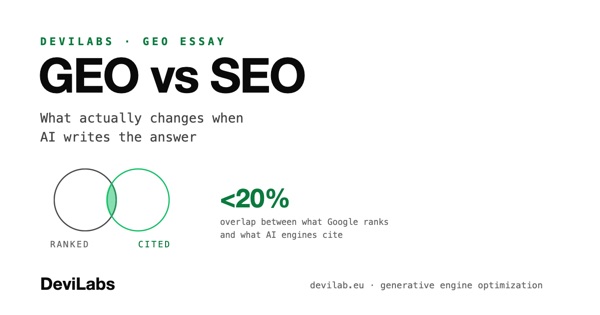
GEO vs SEO: What Actually Changes When AI Writes the Answer
SEO earns a ranked position and a click. GEO earns a place inside the answer itself. What carries over, what doesn't, where the budget goes.
Read the essay