Do Paid AI Tiers Give Different Answers? How to Test It
What changes when a buyer pays for an AI plan, what the one published tier test can and cannot show, and a three-state test that separates the plan from the login and from plain noise.

In this article
Yes, paid AI plans can give a buyer different answers about your brand. Three things change with the account: which model answers, what the assistant remembers, and how it personalizes. The only public tier test we found had the default tier fail where the top tier succeeded, but it ran each tier once. This guide shows what the vendors say changes and how to test it properly.
What changes when a buyer pays for an AI plan?
Three separate things change, and each needs its own control. The plan decides which model answers. The account holds memory and history that can steer an answer toward what that person asked before. Some engines also personalize from wider account activity. Treat all three as one thing called "logged in" and you cannot tell which one moved your result.
Here is what the vendors' own pages say, read on 7 October 2026. For Google, this covers Gemini inside AI Mode in Search, not the standalone Gemini app.
| Engine | What the plan changes | What the account adds | Source |
|---|---|---|---|
| Google AI Mode | Subscribers can choose Gemini 3 Pro; more access on higher plans | Personalization from search history (18+); memory in the US, in English | Google blog, Google One, Search Help |
| Claude | Pro adds "More Claude models" over Free | Memory and incognito chats on every plan | Claude pricing page |
| ChatGPT | Not confirmed for this guide; check OpenAI's pricing page | Not confirmed for this guide | — |
| Perplexity | Not confirmed for this guide; check Perplexity's pricing page | Not confirmed for this guide | — |
Google is the clearest case. Its December 2025 announcement says subscribers can pick Gemini 3 Pro by tapping "Thinking with 3 Pro" in the AI Mode model drop-down. The same announcement brought Gemini 3 to AI Mode in nearly 120 countries and territories in English, so the model difference can reach EU buyers who search in English. Google's plans page describes AI Ultra as giving higher access to Gemini 3 Pro in AI Mode and AI Pro as expanded access, so access scales with the plan rather than switching on and off.
Personalization has narrower limits. Google's help page says AI Mode personalization needs you to be 18 or older with history and personalized recommendations turned on, and the memory feature in AI Mode is available in the US, in English. The plans page lists early access to Personal Intelligence in AI Mode as a US-only subscriber benefit. For a store selling mainly in Germany or the Netherlands, the plan's model is the variable to test first; AI Mode memory is not offered there yet.
Anthropic's Claude pricing page lists "More Claude models" among the Pro additions, and its comparison table marks Opus as unavailable on Free. Memory and incognito chats are on every plan, free included, so a free Claude user can still carry history into an answer.
We could not confirm OpenAI's or Perplexity's current plan line-ups for this guide, so the table leaves those cells open instead of guessing. That becomes step 0 of the test below: before you capture anything, open each vendor's pricing page and write down which model each plan gets that month.
What the one published tier test found
CFI.co ran the only public tier test we found on 13 August 2026, asking four systems on default and top tier for a figure only it had published. It says only three pairs were comparable and shows Claude's top-tier answer alone. On the default setting, two of the three got it wrong: one invented a number, one gave no answer.
The publication was testing whether AI cites it, and the write-up is careful. It publishes its screenshots, voids two runs where the question was pasted in as a statement, and says where the effect did not appear: Gemini answered correctly at every setting. It also notes that Perplexity was tested on a Pro subscription, below that platform's two highest models. ChatGPT's default tier produced a specific wrong number with a percentage computed from it; its top tier returned the correct count and cited CFI.co.
What it cannot show is how often this happens. The whole exercise was twelve captures over four systems in one afternoon, and each tier ran once. Our measurement protocol states that "a single run of a single prompt tells you almost nothing", because the same prompt can return a different answer on the next run with nothing changed. A one-run comparison cannot tell a tier effect from that variation.
It was also an obscure-fact question, the kind where a stronger model with better search wins. Your buyers mostly ask commercial ones: "best vitamin C serum for sensitive skin", "Allbirds alternatives". Nobody has published a repeated tier test on prompts like those. Read the CFI.co result as a case study from a publisher testing its own visibility, and as a reason to run your own check.
Logged in or logged out: what each side gets right
Tracker vendors disagree on whether to measure logged in or logged out, and each side has a fair objection to the other. Logged-out testing can miss tools that account holders get. Logged-in testing with memory on measures one person's history. The answer is a logged-out baseline, plus deliberate tests that change one account variable at a time.
Discovered Labs argued in October 2025 that logged-out ChatGPT did not have the same web search tooling as users with free or paid accounts, and proposed testing through the API with authentication instead. ThriveStack's fact-check, updated September 2026, says to always measure with clean, non-personalized, incognito API sessions rather than logged-in personal accounts. A third option is to run prompts inside a logged-in account with memory left on.
The first two both end up at an API, which is a different surface from the app a buyer uses. We capture from consumer interfaces, not APIs, because the consumer interface is what a buyer actually sees, and the protocol specifies "fresh, logged-out sessions per run — no chat history, no personalisation, no memory". Our AI Visibility Audit runs under the same clean-room conditions: logged out, memory off, fresh session per prompt.
We have not re-checked logged-out ChatGPT's search tools for this guide, and that claim is a year old. So test it: if an engine's logged-out answers show no web sources, or the engine will not answer without signing in, its baseline becomes a free account in a temporary or incognito chat with memory off. The comparison between that free account and logged-out then tells you what logging in alone changes.
The memory-on option has the opposite problem. An account that has asked about your brand fifty times can bring your brand up for reasons no buyer shares. When we scored the seven pages ranking for "how to measure AI visibility" on 28 September 2026, none told readers to measure logged out, so a reader following any of them would not know to record which state their numbers came from.
How to tell a tier effect from ordinary volatility
Compare a paid account with a free account, both with memory off, and call a prompt tier-sensitive only when all three runs agree within each state and the two states disagree. Then check how often that rule fires when nothing changes at all. If the paid comparison does not clearly beat that background, the plan is not moving your numbers.
Our protocol scores every prompt three times per engine and takes the majority, with disagreement "recorded as volatility rather than averaged away". For a tier comparison, this guide tightens that to three out of three, because a two-out-of-three result flips easily and you are stacking two of them.
Step 0: open each engine's pricing page and record which model each plan gets that day, and whether logged-out answers on that engine show web sources. Pick one engine and three states: logged out, a free account with memory and personalization off, and a paid account with the same settings. Comparing paid with logged-out mixes the plan with being logged in. Run every prompt three times in each state on the same day, same location and language, same product mode on every engine (for example, AI Mode rather than AI Overviews). Run the logged-out state on the same day as well, or reuse the baseline only if it was captured that day. Then run the free state a second time, three runs again: that is your placebo pass. Score each run the way you score the baseline: is the brand named, is it in the top three, is the description correct. Count the prompts where free and paid are each unanimous and disagree. Count the prompts where the two free passes are each unanimous and disagree. Treat the plan as real only if the first count is at least double the second and at least three prompts out of thirty.
The doubling threshold is this guide's rule of thumb, not a statistical test. It is deliberately conservative: a tier panel that only matches the placebo has found noise. The free-versus-logged-out comparison, read the same way, tells you the login effect separately.
A worked example: one store, one paid panel
Take a US Shopify skincare brand with 30 commercial prompts such as "best fragrance-free moisturizer for rosacea". The baseline runs each prompt three times on four engines: 360 captures a month. A same-day panel on one engine (free, paid and a second free pass) adds 270 more captures, so 630 captures in total.
That panel is 75% more capture work than the baseline. Our guide to measuring AI visibility estimates two to four minutes per run to capture and log, so the panel costs between 9 hours and 18 hours a month by hand. The subscription for one paid account is small next to that.
Which engine? The one your buyers use most. A checkout question ("Where did you first hear about us?") with an AI assistant option answers that faster than any tool; our guide to tracking AI traffic in GA4 explains why the analytics channel alone undercounts it. For a US skincare buyer, Google AI Mode is a strong candidate because the paid model sits in the same search box most buyers already use. An EU store should pick whichever engine its checkout survey names most often.
Reading the results works like this, with illustrative numbers. Say 2 of the 30 prompts flip between the two free passes, and 6 flip between free and paid. Six is at least double two and at least three, so the plan is moving answers on this engine. If 5 flipped between free and paid and 4 between the free passes, you have found noise. For each tier-sensitive prompt, compare the sources the paid answer cites with the ones the free answer cites, and look for the ones that do not mention you.
Report the panel next to the baseline, never inside it. Your headline AI presence rate stays on the baseline, so each month stays comparable even when a vendor changes which model each plan gets.
What to do this week
Spend about an hour on a smoke test before you spend money. Take five commercial prompts. Run each once in a logged-out window, once on a free account in a temporary chat, and, if you already pay for a plan, once on that account with memory off. Then run them on your normal account with memory on.
One run each proves nothing on its own. Any prompt where your brand appears in one state and is missing in another is a reason to run the three-state panel above. If the memory-on answers look better than all the others, you have found a common self-deception: your own account flattering you. And if a tool or agency reports your AI visibility, ask which interface, which account state and which plan their numbers come from.
Frequently asked questions
It may, but nobody has published a repeated, controlled test on commercial prompts that shows how often. On Google AI Mode and Claude, the vendors' own pages show paid plans adding models free users do not get. Check OpenAI's pricing page for which model each plan gets that month, then run the three-state test in this guide.
Logged out for the numbers you report month to month, because that state is reproducible and carries nobody's history. Where an engine will not answer logged out, or answers without web search, use a free account with memory off instead. Test paid plans against that free account, never against logged-out.
Ask the vendor three questions: which interface they capture from (consumer app or API), whether the account is logged in, and which plan and model that account uses. If they cannot answer all three, you cannot tell whose answers you are paying to see.
It can. A memory-enabled account that has asked about your brand many times may bring it up because it knows you, not because buyers see it. Check your brand in a logged-out window or a temporary chat before you treat your own screen as evidence.
Because a two-out-of-three result flips easily by chance, and a tier comparison stacks two such results. Requiring three out of three in each state means a difference between states is unlikely to be noise from either side. The placebo pass then tells you how often that strict rule still fires on nothing.
Sources
- Gemini 3 and Nano Banana Pro in Search are coming to more countries around the world. — Google, Dec 1, 2025.
- Google AI plans with Cloud Storage - Google One — Google One.
- Personal Intelligence: How AI Mode in Search personalizes responses for you - Google Search Help — Google Search Help.
- Plans & pricing | Claude by Anthropic — Anthropic. Pro plan additions over Free; read 7 October 2026.
- Which model they ask decides what they hear about you — CFI.co, Aug 15, 2026.
- Why AI Visibility Trackers Are Not Measuring What You Think They Are | Discovered Labs — Discovered Labs, Oct 3, 2025.
- Fact-Check: Does a ChatGPT memory mention count as AI? — ThriveStack, Sep 28, 2026.
- GEO Measurement Protocol — DeviLabs, Aug 8, 2026.
- Pricing — DeviLabs.
- How to Measure AI Visibility — DeviLabs, Sep 30, 2026.
How this article was made: researched and drafted with AI assistance, built on DeviLabs’ published methods and Dominykas Jankauskas’s own positions, then fact-checked against the primary sources listed above and reviewed before publication. Read the full editorial policy. Spotted an error? Email info@devilab.eu.
Baseline first, opinion second
The GEO Measurement Protocol is the documented, reproducible procedure DeviLabs runs before touching anything: six phases, four engines, a 30-day window, and a plain statement of what the evidence supports.

Founder of DeviLabs, a Generative Engine Optimization (GEO) agency in Wassenaar, the Netherlands. He leads the agency’s GEO practice and its AI-native creative production, working with DTC, ecommerce, SaaS and SMB brands across the European Union and the United States.

How to Measure AI Visibility Without Fooling Yourself
Your agency's green arrow may be sampling noise. How to put an honest error range on an AI visibility number, with the spreadsheet formula.
Read the guide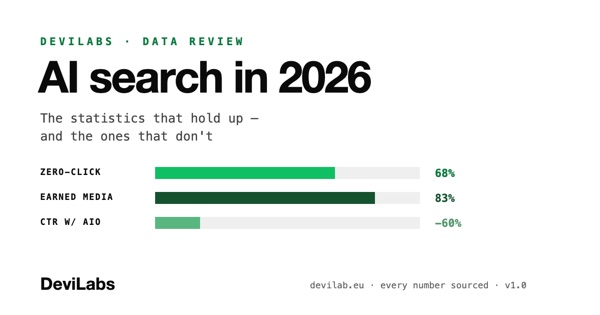
AI Search in 2026: The Statistics That Hold Up — and the Ones That Don't
Zero-click at 68%, AI Overviews cutting CTR ~60%, earned media driving ~83% of citations. Every number sourced, the shaky ones flagged.
Read the data review
Your AI Traffic Is Hiding in Direct: How to See It in GA4
Most AI-referred visits arrive without a referrer and land in Direct. The one-hour GA4 setup that recovers the measurable share.
Read the tutorial